NDIS in 2026: claiming, plan utilisation and the AAT path
What disciplined NDIS providers are doing differently in 2026 — capturing unfunded effort, validating every claim, modelling plan utilisation and building defensible AAT briefs.
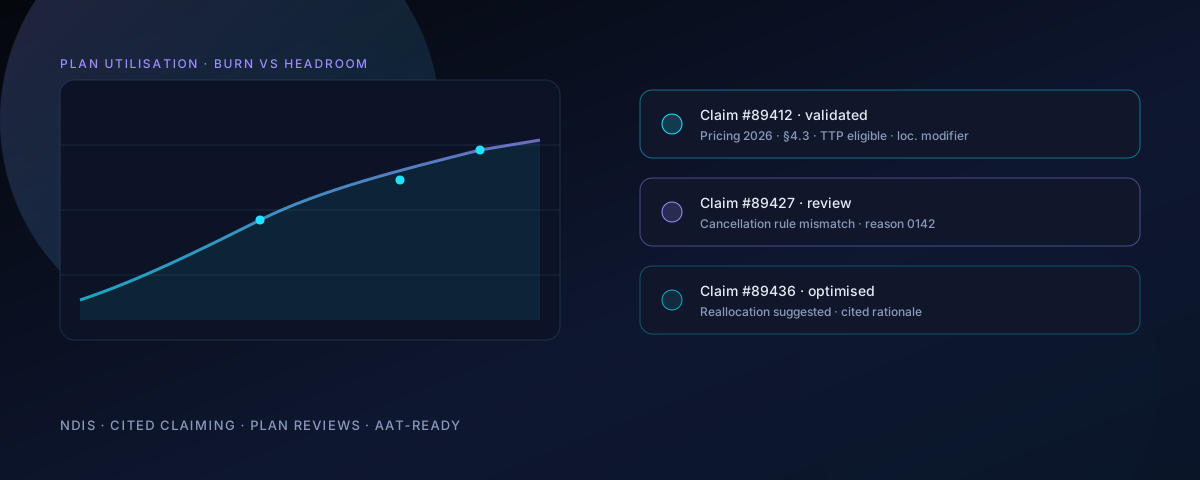
At a glance. NDIS providers in 2026 are squeezed between sharper claiming rules, plan‑review timing pressure and rising clawback risk. The providers we see thriving have stopped relying on heroic month‑end reconciliations and rebuilt the claiming pipeline as a daily operational practice — supported by deterministic validation, cited reasoning and a clear path to AAT when participants need it.
NDIS pricing and claiming have always been intricate. In 2026 the intricacy comes with sharper consequences: tighter audit attention, more rigorous plan‑review expectations and a population of participants who increasingly expect their providers to defend the work in writing. The good news: the operational pattern that solves it is not exotic. It is daily discipline, well‑instrumented, with the right boundary between deterministic computation and AI assistance.
This is a practitioner note for CFOs, finance managers, support coordinators and clinical leads inside Australian NDIS providers. It is not legal or NDIS Act advice; it is the operational shape we see working at scale.
Three forces reshaping the claiming pipeline
- Pricing precision. The NDIS Pricing Arrangements continue to grow more granular — geographic modifiers, TTP eligibility, support‑item conditions, travel rules and time‑of‑day variations. A claim is no longer “did we provide the service?” but “did we claim the right line for the right participant in the right window with the right modifiers?”
- Plan utilisation visibility. Participants and their planners expect transparency. A provider who cannot quickly show how much of which budget has been used, and what is projected to remain will lose trust well before the next plan review.
- AAT and review pressure. When participants need to challenge a plan or a price decision, the quality of the evidence pack matters more than the eloquence of the cover letter. AAT‑grade briefs are now table stakes for anyone serving complex participants.
The four operational disciplines we see in strong providers
1. Capture unfunded effort, every shift
Unfunded support work is the silent margin killer. A worker spends fifteen minutes on a phone call about a participant; a coordinator chases a NDIA decision for half an hour; a clinician writes a follow‑up note after hours. Without explicit capture, that effort vanishes from the cost base — and quietly distorts service viability analysis.
Operational target. Web and voice capture for unfunded work in the same UI workers already use. Categorise it. Tie it to participants and support categories. Surface it weekly to leadership so trends are visible long before a quarterly close.
2. Validate every claim deterministically
Validation is not a place for AI to be creative. It is a place for tested code to apply effective‑dated rules:
- Price Guide line for date of service.
- Plan dates and budget headroom.
- TTP eligibility uplift.
- Location modifier (remote, very remote).
- Service agreement terms.
- Cancellation rules.
- Travel claim conditions.
The output for each claim should be a structured pass/fail with rule citations. A failure should give finance a reason code that someone non‑technical can act on — not a paragraph of natural language that has to be re‑translated into action.
3. Optimise claims with cited reasoning, not vibes
Where AI earns its keep is in the monthly batch optimisation: line‑item matching, duplicate detection, cancellation handling, suggesting reallocations across categories where that is permissible. The reasoning should always be cited — here is the rule, here is the participant context, here is the reason for the suggested change — and persisted with the claim record.
A practical test: if a senior manager pulls a random claim from last month, can you reconstruct the rationale in under thirty seconds? If yes, your audit posture is strong. If you have to read four screens of model output, your team is doing extra work to defend AI suggestions.
4. Forecast plan utilisation as an operational instrument
A plan is not a static budget. It is a velocity model. Strong providers track:
- Spend by support category, weekly.
- Burn rate against the remaining plan window.
- Projected exhaustion date by category.
- Re‑allocation opportunities that respect plan rules.
Surface this to support coordinators before plan reviews — not in the panicked week before. The conversation with the planner becomes a confident, data‑backed proposal rather than a rescue plea.
When you have to go to AAT
A small percentage of plan or pricing decisions need to be challenged. AAT briefs reward providers who can produce:
- A coherent service narrative linked to assessed needs.
- Evidence of attempted reasonable adjustments before review.
- A funding gap analysis quantified in dollars and hours.
- Citations to the Pricing Arrangements, Operational Guidelines and the participant’s own plan.
- A clear ask — what reallocation, increase or assessment is being requested, and why.
This is exactly the kind of artefact AI can scaffold and a human can sign off — provided the underlying numbers come from validated, deterministic sources, and the citations come from a corpus your audit can replay months later.
Where CareFinIQ fits
CareFinIQ is built for this specific operational shape. Unfunded work capture lives where workers already are. Smart claim validation uses deterministic rules and structured failure codes. Claim batch optimisation uses cited reasoning that finance can defend. Plan utilisation surfaces burn and reallocation alerts. And the NDIA evidence and AAT appeal builder assembles plan‑review, price‑review and AAT briefs ready for human review and PDF release.
We do not pretend the platform replaces clinical or coordination judgement. We do believe it removes a lot of repetitive evidence drag — so the experts you employ can spend more time with participants and less time with spreadsheets.
A board‑level dashboard worth ten reports
A monthly NDIS dashboard you can defend to your board should answer five questions in under five minutes:
- Funded vs unfunded effort by category and team — trend over the last six months.
- Claim validation pass rate, with reason codes for failures.
- Plan utilisation by participant cohort, with projected exhaustion alerts.
- Service viability — margin by support category and program.
- Open evidence packs — how many plan/price reviews and AAT briefs are in progress, and where they are in the lifecycle.
If your current month‑end produces those five answers without manual reassembly, you have an operating system. If it does not, you have a project worth doing.
A careful disclaimer
opzo.ai is not your NDIS lawyer or your professional adviser. NDIA Operational Guidelines, Price Guides, scheme rules and your service agreements always prevail over a vendor blog. Treat this as a structuring scaffold; align it with your own legal, clinical and risk advice.
Next step
If you would like a tailored review of your claiming pipeline — which controls are deterministic today, which rely on review, where the evidence pack is thin — book a 30‑minute conversation. We will bring an NDIS claiming readiness checklist you can take away, regardless of whether you adopt CareFinIQ.