The supplier‑compliance crunch: Modern Slavery, Cyber and Privacy in 2026
Australian SMEs are drowning in buyer questionnaires. Here is the operating pattern that turns one‑off compliance theatre into a reusable Compliance Passport — and a competitive advantage.
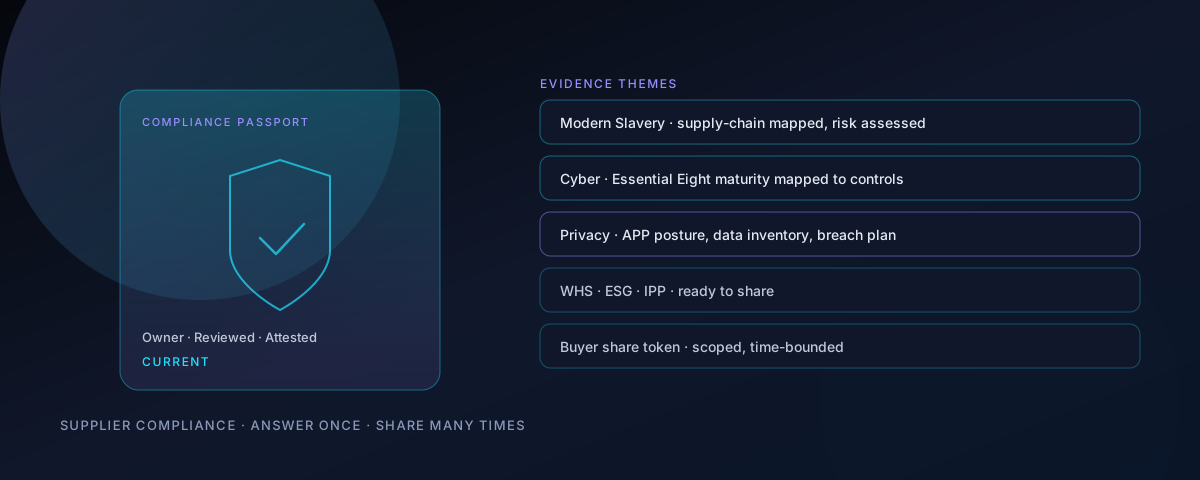
At a glance. Buyer‑imposed obligations have stacked up faster than supplier capacity to meet them. Australian SMEs in 2026 spend disproportionate effort on compliance questionnaires for Modern Slavery, cyber security, privacy, ESG, WHS and Indigenous Procurement. The pattern that breaks the cycle is a reusable Compliance Passport — answer once, share many times — backed by an Evidence Vault and a buyer‑specific declaration generator. This is what disciplined SMEs are doing differently.
Supplier compliance was always part of doing business with large enterprises and government. In 2026 it has become a distinct cost centre. Each buyer asks a similar but subtly different version of the same questions; each answer has to be defensible, current and signed by someone authorised to sign. For an SME competing for tenders, the compliance burden can quietly consume the bid team’s capacity.
This is a working pattern for owners, COOs and bid managers in Australian SMEs supplying enterprise and government. It is not legal advice; it is the operating shape we see scaling well.
The shape of the problem
Look at any mid‑market Australian supplier’s last twelve months of buyer requests and you will see the same six themes recur:
- Modern Slavery Act statements and supplier questionnaires.
- Cyber security posture (Essential Eight, ISO 27001 alignment, SOC 2 references).
- Privacy posture under APP and reform expectations.
- WHS and contractor management evidence.
- ESG and emissions disclosures.
- Indigenous Procurement Policy (IPP) statements where applicable.
Each request lands in a different inbox, on a different template, on a different deadline. The same evidence is reformatted endlessly. The same person — usually the most senior person who understands the business — signs over and over.
Why traditional approaches fail
Three patterns we see breaking down:
- The shared drive. Evidence accumulates in folders that nobody trusts to be current. Every questionnaire begins with “let me check what we said last time”.
- The hero spreadsheet. A single team member maintains a master answers list. When they leave or take leave, the institutional knowledge leaves with them.
- The bid swarm. Each bid team rewrites the answers for its specific opportunity, in the language of that buyer’s portal, without coordination across deals.
None of these scale. All of them generate inconsistency that buyers (rightly) flag in compliance reviews.
The Compliance Passport pattern
The pattern that scales is to make the evidence the source of truth — not the questionnaire. Treat your compliance posture as a Passport: a single, current, attributable picture of who you are, backed by an Evidence Vault of attested artefacts. Then generate declarations for buyers from the Passport, instead of answering buyer templates one by one.
A working Passport has four properties:
- Attribution. Each evidence item has an owner, a review date and an attestation trail. No anonymous PDFs.
- Currency. Items expire; the system warns owners before they go stale; the Passport visibly degrades if maintenance lapses.
- Granularity. Evidence is granular enough to support multiple downstream questions — a single Modern Slavery risk assessment can answer several distinct buyer questions.
- Shareability. A buyer (or their procurement portal) can be given a scoped, time‑bounded view — without the supplier having to email files repeatedly.
Contract and tender scanning
The other half of the problem is understanding what the buyer is actually asking for. Buyer obligations live in dozens of pages of contract or tender text — clauses about cyber, modern slavery, privacy, sub‑contracting, audit rights and incident notification.
A practical workflow:
- Ingest the procurement document (RFP, contract, framework agreement).
- Extract obligations as structured items, each tagged by domain (Cyber, Privacy, Modern Slavery, etc.).
- Map each obligation to evidence already in the Passport.
- Surface the gaps — and route them to the right owner with a deadline.
This is not the place to be vague. Each extracted obligation should reference the clause and page in the source document, with a structured note of what evidence satisfies it. AI does the extraction; humans approve. The audit story is straightforward.
Generating buyer‑specific declarations
Once the Passport is healthy and obligations are mapped, declaration generation is mechanical:
- Pull the relevant evidence subset.
- Apply buyer‑specific language and format.
- Route through your normal approval chain.
- Persist a copy of what was sent, with timestamps and signatories.
A bid that previously took a week of back‑and‑forth becomes a defined production run. The senior signatory still signs — but now signs a defensible artefact, not a frantic last‑minute draft.
Modern Slavery: a worked example
Modern Slavery questionnaires illustrate the pattern at a manageable size. A typical buyer asks:
- Do you have a Modern Slavery policy?
- Have you mapped your supply chain by tier?
- Have you assessed risk by geography and category?
- What grievance and remediation processes apply?
- How is training delivered to staff and contractors?
- What independent assurance has been performed?
A Passport that maintains a current Modern Slavery evidence set answers all of these without fresh effort — and produces a buyer‑specific declaration with traceable evidence references. When the same buyer comes back next year, the system updates around the parts that changed; the rest is reused.
Cyber security: aligning to Essential Eight
Cyber questionnaires increasingly map to the ACSC Essential Eight maturity model. Treat each control as an evidence theme with its own owner and review cadence:
- Application control.
- Patch applications.
- Configure macro settings.
- User application hardening.
- Restrict administrative privileges.
- Patch operating systems.
- Multi‑factor authentication.
- Regular backups.
When a buyer asks for cyber attestation, you assemble a current Essential Eight snapshot — not a hastily worded paragraph that may or may not align to last quarter’s reality.
Privacy: APP and the reform direction
APP compliance is no longer well‑served by a single privacy policy PDF. Buyers want:
- A data inventory appropriate to your size.
- A privacy impact assessment pattern for new projects.
- Evidence of breach response preparation.
- Sub‑processor disclosures for any cloud or AI services that touch buyer data.
The Passport keeps each of these current and attestable, ready for the next questionnaire.
Where WhiteTape fits
WhiteTape is engineered for this pattern end to end. The Compliance Passport is the system of record. The Evidence Vault holds attested artefacts with owners and expiries. The Contract and Tender Scanner extracts buyer obligations with citations. The Declaration Generator drafts buyer‑specific responses with evidence references and routes them through approval. Modern Slavery and Cyber modules ship with structured workflows; Buyer share tokens let you grant scoped, time‑bounded access without emailing a single PDF.
The aim is simple: answer compliance questions once, share many times, sleep well.
A board‑level perspective
For owners and directors, the test is not “did we win this bid?”. The test is:
- How much senior‑leader time was spent answering compliance questions this quarter?
- What is the trend?
- Is our current win rate constrained by compliance friction rather than commercial fit?
- Could we walk a regulator or a buyer through our compliance posture in under an hour, today, with current evidence?
If the answer to the last question is uncomfortable, the operating pattern in this piece is the lowest‑risk way to fix it.
Next step
If you would like a 30‑minute walkthrough of the Compliance Passport pattern adapted to your buyer mix — government, enterprise, infrastructure, healthcare — book a conversation. We will bring a starter Passport scaffold and a sample obligation extraction from a real (redacted) tender, regardless of whether you adopt WhiteTape.