Why we put deterministic engines under our AI
A field guide to hybrid AI architecture — when language models should propose, when code must decide, and how to keep both honest in regulated Australian workloads.
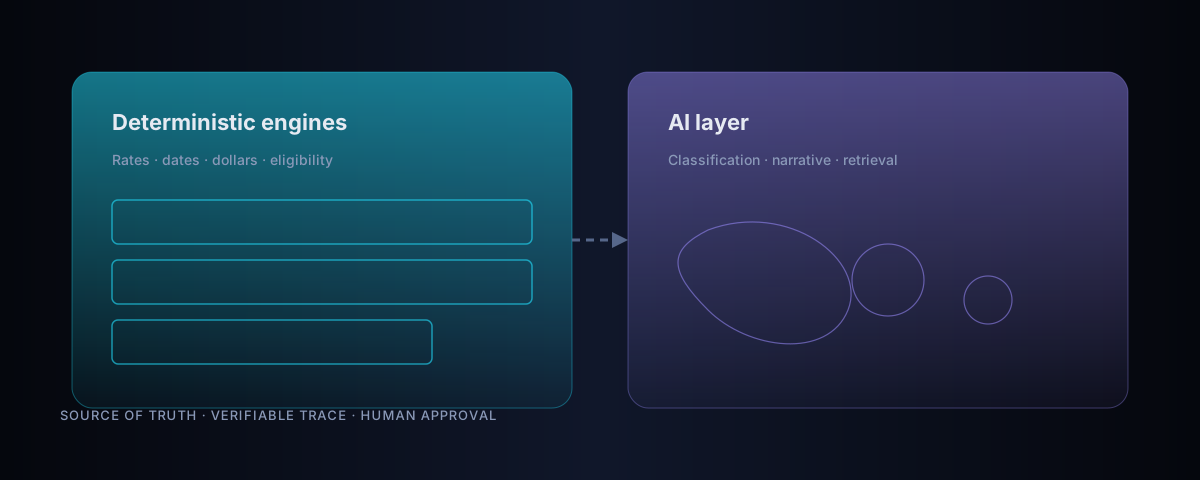
At a glance. Language models are excellent at classification, retrieval and narrative. They are unreliable for arithmetic, dates, eligibility and rule lookup. Production AI in regulated Australian industries needs both layers — but kept on different sides of a deliberate boundary. This piece explains how opzo.ai draws that boundary, why “tool‑calling” alone is not enough, and the failure modes teams avoid when they get the layering right.
If you have watched a large language model confidently invent a statute subsection, mis‑total a payslip or “smooth” an award rate to a nearby round number, you already understand why deterministic engines belong underneath enterprise AI in regulated domains. The surprise is how much vendorware still allows dollars, deadlines and eligibility to be implied by model text rather than produced by tested code.
This is not an argument against AI. It is an argument for separation of duties. AI excels at classification, retrieval, synthesis and narrative; deterministic engines excel at replayable arithmetic, date logic, versioned rules and explicit failure modes. When you merge those roles by accident, you inherit a defect class that auditors, insurers and professional bodies can see from a long distance.
The core invariant
If a stakeholder could reasonably lose money, licence or liberty because a value is wrong, that value should not originate from an LLM.
That value might be: an hourly rate after penalties; an NDIS support‑item outcome; a grant cost category; a withholding threshold; a statutory filing deadline; a billable amount that lands on an invoice. Language models can suggest paths; they should not silently become the ledger.
Instead, the platform should force a choreography you can draw on a whiteboard in thirty seconds: propose → validate → approve → persist — with validation coming from code that references versioned sources, not vibes.
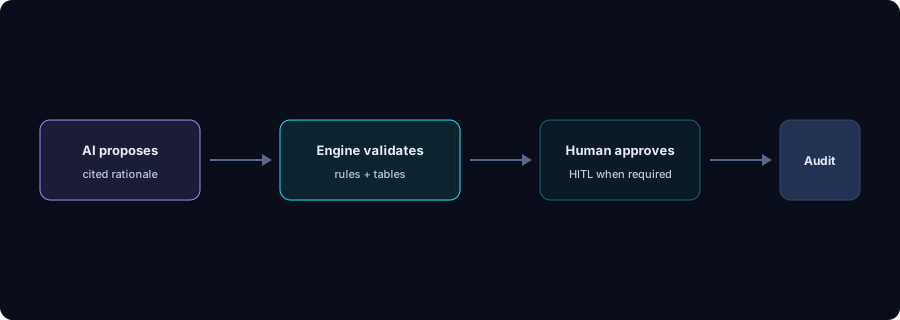
Figure: The golden path. Each stage has different evidence expectations and testability.
Why “tool calling” is not enough on its own
Modern agents can call calculators or SQL. That is helpful for demos but insufficient as governance. Without guardrails, the model chooses when to call a tool, interprets the tool’s output, and may overwrite structured results with natural language summaries — sometimes drifting from the numeric truth by a rounding error, sometimes by an entire clause.
Production systems need non‑optional validation stages: structured outputs from engines that throw typed errors; deterministic diffs when corpus versions change; and a UI that makes it obvious whether a value is provisional (model‑suggested) or committed (engine‑certified).
Pattern in payroll: WageGuard’s split brain
Payroll is the canonical example because every Australian payroll professional has seen “the system said so” fail a Fair Work audit.
Classification is fuzzy. Awards intersect with contracts, agreements and roster patterns. A language model can propose an award path with citations — provided retrieval is grounded and traces are persisted. That is legitimately “AI work”.
Calculation is not fuzzy. Once the path is fixed, penalties, overtime, allowances and superannuation should be computed by deterministic code against effective‑dated tables. The same roster and clock events must replay to the same dollars tomorrow — an invariant you can unit test.
We keep those worlds apart on purpose: agents propose; calculators commit; humans resolve edge cases where policy genuinely conflicts. The audit story becomes legible — Here is the classification trace; here is the engine version; here is the rule row.
WageGuard is built around that boundary; see also Payday Super 2026: a readiness playbook.
Pattern in care economics: CareFinIQ and NDIS pricing mechanics
NDIS claiming sits at the intersection of policy text, price guides, participant plans and operational reality. Teams routinely face questions like: does this support item apply given the participant’s geography and plan? Is travel funded for this scenario? Does a modifier apply, and under which published rule?
An LLM can narrate why a claim might fit — which helps humans learn fast — but eligibility maths and line construction must resolve to explicit, citeable checks. Deterministic engines should answer yes/no with pointers to corpus fragments, not essay‑level hand‑waving.
A practical consequence: when a claim fails, you want a structured reason code that finance can reconcile — not a paragraph that sounds plausible but is expensive to verify at month end. (CareFinIQ is engineered to that pattern.)
Pattern in professional services: ClauseIQ‑style assurance
Legal and audit‑adjacent workflows often require a four‑eyes pattern: a primary reasoning path, and a senior “judge” model tier‑separated from the drafting model, with human sign‑off before client‑visible artefacts ship.
Determinism still matters here — even when law is interpretive — because dates, filing windows, fee schedules and cross‑references frequently tangle with numeric or calendar logic. Engines handle those intersections; models handle argument structure and evidentiary narrative under human control. (ClauseIQ implements this as a first‑class pipeline.)
Failure modes when you blur the boundary
We have seen variants of the same production failures across industries:
- Numeric hallucination dressed as authority. Pretty prose with wrong thresholds. Fixing the sentence does not fix the payment.
- Non‑reproducible audits. Runs differ because prompts, temperature or tool ordering drift. Regulators and partners ask for replay; teams cannot provide it.
- Hidden data dependence. Models implicitly learn from logs containing sensitive fragments; your privacy model assumed “no training” but operational replay breaks the assumption.
- Responsibility fog. When anything could have been “the AI”, nobody owns the outcome. Governance requires crisp ownership boundaries.
A compact comparison
| Concern | LLM‑only shortcut | Hybrid (engine + AI) |
|---|---|---|
| Replay on audit | Fragile | Engine outputs are versioned and repeatable |
| Error characterisation | Narrative | Typed errors tied to rule IDs |
| Testing | Prompt snapshots | Unit and property tests on calculators |
| Human workload | Review full text | Review exceptions and edge cases |
| Buyer trust | “The model said…” | “Engine v3.2 with corpus 2026‑04‑01 said…” |
How this influences product UX
Good UX makes the layering obvious: proposed classifications appear as suggestions with citations; computed dollars appear with engine badges and corpus pins; approvals stamp an immutable record. Great UX routes exceptions — when engine and model disagree, the ticket lands on a human with both traces, not a thread guessing which side to believe.
A whiteboard test before you ship
Before any AI feature touches production in a regulated workflow, put one question on the whiteboard:
Which numbers on this screen are allowed to change if we re‑run the LLM with a different seed?
If the answer is “none without a human touching them”, you are in the right neighbourhood. If the answer is “a few”, you are owed a frank conversation with your engineering, compliance and risk leaders before go‑live.
Closing
Australian regulated buyers are not allergic to AI — they are allergic to unbounded AI touching bound variables. Deterministic engines are how you keep the magic where it helps and the boring correctness where it must be boring.
For a deeper walkthrough on how opzo.ai applies this pattern across the suite, book a demo. We will happily stress‑test a workflow you bring (redacted) against this architecture.