Sovereign AI in Australia: what changed in 2026
Why Australian-sovereign AI is now an architectural question — not a hosting checkbox — and the procurement diligence regulated buyers are bringing to the table.
At a glance. “Hosted in Australia” is no longer a complete answer. Embeddings, inference endpoints, reasoning traces and observability pipelines all carry data — and any of them can quietly egress offshore. Sovereign AI in 2026 is a data‑plane question, not a region sticker. This piece sets out the diligence pattern we see from regulated Australian buyers, and how opzo.ai is engineered to satisfy it.
For much of the last decade, “Australian sovereignty” in enterprise software sounded like a procurement footnote: tick the box that primary databases live in Sydney, file the security pack, and move on. That standard was always too narrow for serious risk management. In 2026 it is visibly obsolete as a sole standard. Regulated Australian organisations are now scrutinising the entire AI data plane — embeddings, vector indexes, inference endpoints, reasoning traces, observability pipelines and the incidental copies of customer content those systems create.
If your platform stores vectors offshore, routes an LLM call through a non‑Australian endpoint, or ships telemetry containing cited excerpts to a foreign SaaS, you have not built an Australian‑sovereign AI stack. You have built an AI stack with an Australian storage footnote.
This is a practitioner‑grade framing of what changed, what to ask vendors, and how to think about accountability. It is not legal advice — it is the technical and procurement pattern we see in banking, care, professional services and the public sector as AI moves from experiment to operational workload.
When “hosted in Australia” stopped being the whole story
Traditional SaaS diligence focused on durable data at rest: CRM rows, documents, payroll tables. AI systems add three categories that buyers routinely underestimated:
-
Derived representations. Embeddings are not “just numbers”. They are partially reversible, correlatable across corpora, and exploitable in prompt‑injection and exfiltration scenarios when combined with retrieval pipelines. Where embeddings live is as material as where source PDFs live.
-
Ephemeral but sensitive inference. Even when prompts are not logged verbatim, side channels exist: token traces, moderation classifiers, safety filters and vendor‑side abuse‑monitoring can create copies you did not model in your privacy assessment.
-
Operational artefacts. Reasoning traces, chain‑of‑thought scaffolding, judge‑model reviews and human‑approval metadata constitute high‑granularity decision records. If those artefacts replicate to an international observability tool, your sovereignty story breaks — even if customer source documents never left Sydney.
None of this is hypothetical to teams running RAG at scale. It is the daily geometry of production systems.
The sovereignty checklist we see in real diligence
The questions below are distilled from workshops with CIOs, CISOs and privacy officers across NDIS providers, aged‑care groups, legal partnerships and regional banks. They separate sovereign by architecture from sovereign by slide deck.
| Theme | What “good” looks like in 2026 |
|---|---|
| Inference region | Azure OpenAI (or equivalent) endpoints pinned to Australian regions — not merely an Australian account with a fallback route. |
| Vector and search | Vector indexes and search services provisioned in AU regions, with a documented no‑egress posture for indexed content. |
| Embeddings lifecycle | Key material, job queues and worker logs that touch document text remain onshore; no “temporary” US buffer buckets. |
| Reasoning traces | Persisted traces, citations and HITL decisions stay inside AU tenancy boundaries; replicated only to AU paired regions. |
| Observability | APM, logging and SIEM destinations are explicitly data‑mapped; no silent replication of message payloads offshore. |
| Network controls | Deny by default international egress from data‑plane subnets — not “we promise not to”. |
| Subprocessors | A current list naming AI providers, embedding services and incident vendors — including subprocessors of subprocessors — with residency surfaced. |
| Continuity | Failover region is also Australian (East ↔ Southeast). No DR plan that quietly invokes US restore. |
If a vendor hesitates on any row, treat that hesitation as architecture debt you will inherit on day two — usually the day after a regulator, insurer or major customer asks for evidence.
Why embeddings and traces moved to the centre of the conversation
Australia’s privacy reforms and automated‑decision‑making (ADM) transparency expectations are converging with global supply‑chain risk. You no longer need a theoretical harm for regulators to ask sharp questions; you need an evidentiary trail showing how a decision was reached, what sources were consulted and who approved high‑stakes outputs.
That trail is exactly what modern AI systems should produce — but only if engineered deliberately. A sovereign stack makes three commitments that are difficult to retrofit:
Attribution. Every material output should trace to source clauses, tables or precedents that a human can locate without trusting opaque model weights.
Replay. Given the same approved corpus version and engine version, a calculation or eligibility outcome should replay identically wherever determinism applies. (See our companion piece, Why we put deterministic engines under our AI.)
Containment. PII and sensitive personal information should encounter detect‑and‑protect gates before crossing an AI boundary, with policies enforced at platform level so individual teams cannot “helpfully” bypass them.
A composite scenario: the offshore observability foot‑gun
Imagine a mid‑size accounting network deploying an assistant that drafts client letters using retrieved precedents. Primary documents live in Australian blob storage — so far, so good. The team wires application performance monitoring that captures full request payloads for debugging. Those payloads include retrieved paragraphs and model completions.
Suddenly, a foreign observability subprocessor processes what amounts to client correspondence. The architecture diagram still shows “AU‑only storage”. The data‑flow diagram tells a different story — and in a breach or regulator inquiry, the second diagram wins.
Fixing this is not a policy memo; it is network segmentation, log redaction, vendor contract surgery and often a different class of tooling. The lesson: sovereignty is a pipelines problem, not a regions sticker.
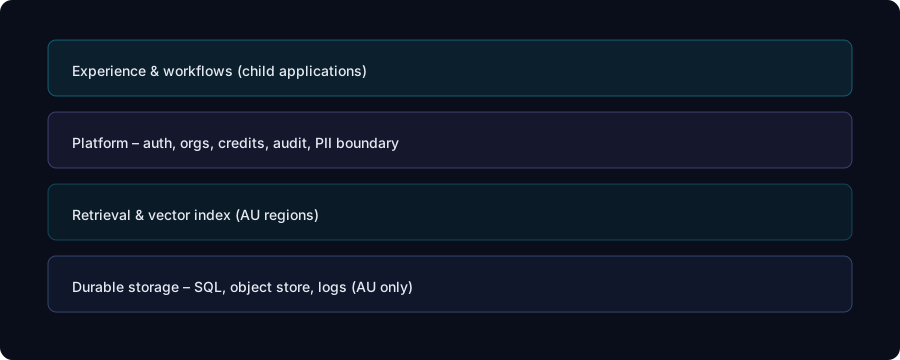
Figure: A simplified stack view. Sovereign posture fails if any layer quietly egresses outside Australian regions.
How platform engineering encodes sovereignty
Organisations that succeed treat sovereignty as non‑negotiable platform invariants — not per‑project guidelines:
- Single‑tenancy expectations for AI keys, quotas and private endpoints — no “shared model router” that obscures where calls land.
- Corpus versioning so audit can bind outputs to the exact regulatory snapshot in effect on a given date — critical for awards, NDIS pricing, grants and statutory instruments.
- Human‑in‑the‑loop choke points for externally bound communications, billing artefacts or statutory declarations — AI proposes; policies route; humans approve.
- Continuous verification rather than annual attestations — automated checks that endpoints, DNS and private‑link configurations have not drifted.
Five questions to put on your next vendor call
When the diligence stage gets short, these five questions separate marketing from engineering:
- Show me the network ACLs that block egress from your AI data plane. Which CIDRs are allowed; which are denied?
- Where do embeddings live, and what is the lifecycle when a customer deletes a document?
- What is logged at the AI boundary by default — and where do those logs land?
- List your subprocessors of subprocessors for inference, embedding and observability, with residency.
- Walk me through a replay of last month’s decision. What versions of corpus, prompts, models and engines were in effect?
If a vendor cannot answer in concrete terms, you have an answer.
What we are optimising for at opzo.ai
Every opzo.ai application inherits the same platform guarantees: Australian Azure regions for compute, storage, retrieval and inference; PII detection at the AI boundary; cited reasoning; deterministic engines for outcomes that must replay; and approvals where professional or statutory stakes require it.
We are unapologetic that this is harder to build than wiring a generic chat box to an overseas API. The organisations we serve do not get second chances on wage underpayments, incorrect claims, mis‑issued legal advice or mishandled care incidents. Their AI stack has to be boring in the right places — especially where numbers, dates, eligibility and dollar amounts are concerned.
Closing
If you take one idea from this piece, let it be this: sovereignty is where your AI pipeline commits state. Hosting was table stakes a decade ago. In 2026, buyers who stop at “data in Sydney” are auditing the wrong diagram. Ask for the data‑flow map, the embedding lifecycle and the inference endpoints — then verify them with architecture reviews, not assurances.
If you would like a short diligence template tailored to AI + RAG workloads in regulated Australian contexts, contact the opzo.ai team. We are happy to share an outline you can drop into your security pack.