Aged Care Act 2024: a working checklist for providers
An operational readiness guide for residential and home‑care providers — Strengthened Quality Standards, SIRS, restrictive practices, care minutes and workforce governance — with practical examples.
At a glance. The Aged Care Act 2024 raised the bar from annual accreditation prep to continuous, attributable evidence. This is the five‑pillar work‑plan we see successful providers adopt — Quality Standards lineage, SIRS narrative, restrictive practices trends, care‑minute modelling and workforce assurance — with concrete examples and the questions a board should ask. Not legal advice; an operational scaffold.
The Aged Care Act 2024 and its associated standards and rules have sharpened what Australian residential and home‑care providers must prove — not once a year during accreditation prep, but continuously. Boards, clinical governance leads and operational executives are now asking a sensible question: If a regulator or advocate challenged us tomorrow, could we reconstruct how we knew we were safe, solvent and compliant — not just that we felt organised?
This checklist is written for operational leaders who already live inside the Act’s vocabulary. It is not legal advice and is no substitute for your own legal, clinical and risk advisers; it is the work‑plan shape we see successful providers adopt when they modernise evidence, incidents, restrictive practices, star‑rating drivers and workforce assurances.
We reference CareSentinel where it maps naturally — because that is the product we build for this sector — but you can treat each item as a capability requirement regardless of tooling.
1. Strengthened Quality Standards: from folder dumps to attributable evidence
What changed in practice. Assessors and board audit committees increasingly expect lineage: which artefact supports which standard, who attested it, when it was refreshed and how you know it still reflects operating reality after roster or model‑of‑care changes.
Concrete example. A provider introduces a new infection‑prevention protocol after a cluster review. Two months later, a clinical lead updates training in the LMS — but the standard‑by‑standard mapping in the accreditation binder still references the January PDF. That disconnect is how “we thought we were compliant” diverges from what frontline teams actually do.
Operational target. Maintain a living map from each strengthened Quality Standard to evidence objects with owners and review clocks. Triggers should include roster changes, contractor mix shifts, incidents with lessons learned and regulator notices.
CareSentinel mapping. Quality Standards modules should surface gap heatmaps (evidence present vs stale vs missing), support self‑assessment cycles and export regulator‑friendly packs that preserve who uploaded or attested each item — not anonymous attachments in a shared drive.
2. SIRS: timelines matter, but triage narrative matters more
Why this is harder than calendars. Serious Incident Response Scheme (SIRS) obligations are not only “did we notify in time?”. They increasingly hinge on why an incident was classified at a priority level, what was known when and how consumers, families and staff were supported while facts were still emerging.
Concrete example. A Priority 2 incident is escalated to Priority 1 after new clinical information arrives 30 hours post‑discovery. A regulator asks: show the decision log, the clinical handoffs, and how communications were managed during uncertainty. If your system only stores “notification sent”, you under‑capture the story you must defend.
Operational target. Pair countdown timers with structured decision notes: triage rationale, notifier identity metadata, attachments indexed to incident phases and immutable timestamps for amendments (with reasons).
CareSentinel mapping. SLA‑aware workflows, phase tagging, regulator‑style exports (ZIP bundles with checksums) and dashboards that executives can read without opening twenty Word documents.
3. Restrictive practices: registers that tell a story, not just a list
The failure mode. Teams maintain a spreadsheet “register” that lists authorisations but cannot quickly answer: Which consumers experienced a practice pattern over time? Which authorisations are near expiry? Which prescribers or behaviour support practitioners need a consolidated review pack for governance day?
Concrete example. A residential service sees two unrelated chemical‑restraint authorisations in a month — each lawful in isolation — while leadership misses the emergent pattern because entries live in separate clinical notes formats. Governance committees need trend visibility early, not after external scrutiny.
Operational target. Tie every authorisation to lifecycle states (proposed, approved, active, due for review, ceased), responsible clinicians, linked behaviour support plans and consumer‑rights documentation. Trend analytics should highlight velocity and recurrence without waiting for manual pivot tables.
CareSentinel mapping. Authorisation lifecycle, register exports and analytics aimed at clinical governance — not only compliance clerks.
4. Care minutes, AN‑ACC and star‑rating narratives executives can stress‑test
Why modelling beats hoping. Star ratings and care‑minute expectations sit downstream of roster reality, agency usage, leave, qualifications mix and consumer complexity. Funding and reputation incentives can collide; executives need scenario planning, not spreadsheets that break when one wing changes hiring plans.
Concrete example. A home‑care provider adjusts visit bundling to improve travel efficiency. The change is operationally sound — yet unknowingly reduces active care time for a cohort with high AN‑ACC needs. Six months later, quarterly reports surprise the board.
Operational target. Maintain a model that ties roster inputs to care‑minute outcomes at cohort levels leadership actually reviews — then run what‑ifs on hiring, agency caps and training pipelines before decisions harden.
CareSentinel mapping. Star‑rating and care‑minute modelling that uses transparent assumptions your CFO and DON can challenge in the same room.
5. Workforce, associated providers and the end of “spreadsheet expiries”
The new normal. Associated providers, verification of workforce credentials and ongoing supervision create a compound workload. Credential lapses are not merely HR headaches; they are gateway risks for incidents, complaints and insurer questions.
Concrete example. A preferred labour‑hire agency rotates staff faster than local orientation records update. Incident reviews reveal a worker whose allied‑health registration actually lapsed two weeks earlier — but payroll still showed “active” because databases were disconnected.
Operational target. One operational view of credentials, orientations, supervision ratios (where applicable) and contractor governance — with proactive alerts before breach, not the day after.
CareSentinel mapping. Unified credential and responsible‑person tracking with escalation paths and board‑readable summaries.
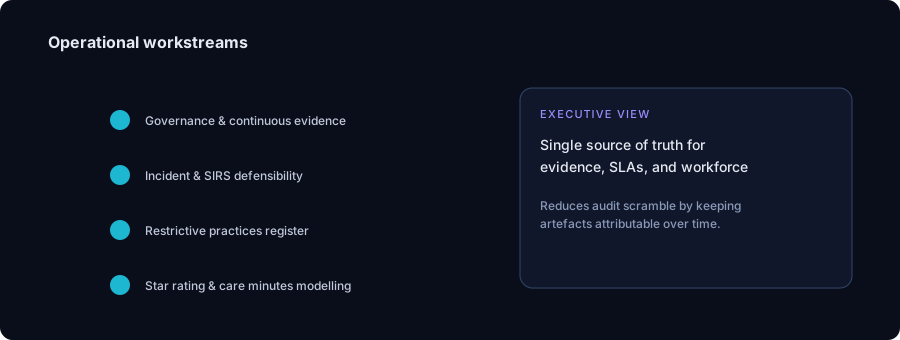
Figure: Continuous readiness requires parallel threads — governance, incidents, restrictive practices, modelling — not end‑of‑quarter heroics.
Board‑ready questions to ask your own organisation
Use this short list in your next governance workshop:
- Can we produce a single executive dashboard tying incidents, restrictive practices trends, quality gaps and workforce risk in under five minutes?
- For any Priority 1 SIRS notification in the past twelve months, can we replay triage decisions with timestamps and named roles?
- Do we know which evidence artefacts are stale against today’s model of care — and who owns the refresh?
- When roster or agency strategy changes, do we pre‑run star‑rating and care‑minute impacts, not post‑hoc surprise?
- Are credential and associated‑provider checks integrated enough that no worker type slips through a blind spot?
If any answer is “we would need a few days to assemble that”, treat the gap as pre‑written audit fatigue.
How to use this checklist with vendors
When evaluating software partners, push past feature lists into evidence mechanics:
- Immutability and audit trails on critical state transitions — not just “logging enabled”.
- Exports that match regulator habits — bundles, indices, checksums — without a professional services project each time.
- Role‑appropriate UX so clinical leaders actually adopt workflows instead of reverting to shadow systems.
- Australian hosting and data handling consistent with your enterprise privacy posture, especially if AI features touch resident narratives. (See Sovereign AI in Australia for the architectural lens.)
- Deterministic computation where dollars, days or eligibility are involved — never inferred by an LLM. (See Why we put deterministic engines under our AI.)
A careful disclaimer
opzo.ai publishes pragmatic guides for operational teams. We are not your lawyer, your aged‑care consultant or your clinical adviser. Statutory instruments, Commission guidance and your organisational policies should always prevail over a vendor blog. If facts align with your programme, use this as a structuring scaffold — not a definitive legal map.
Next step
If you want a tailored readiness review for your service mix — residential, home care or blended — book a 30‑minute conversation. We will bring an Aged Care Act 2024 readiness checklist you can take away regardless of whether you adopt CareSentinel, and we can map where deterministic + AI‑assisted workflows reduce manual evidence drag without weakening clinical accountability.