AI governance for Australian boards: a one‑page operating model
What directors should be asking management about AI in 2026 — covering accountability, evidence, sovereignty, model risk and the boundary between automation and judgement.
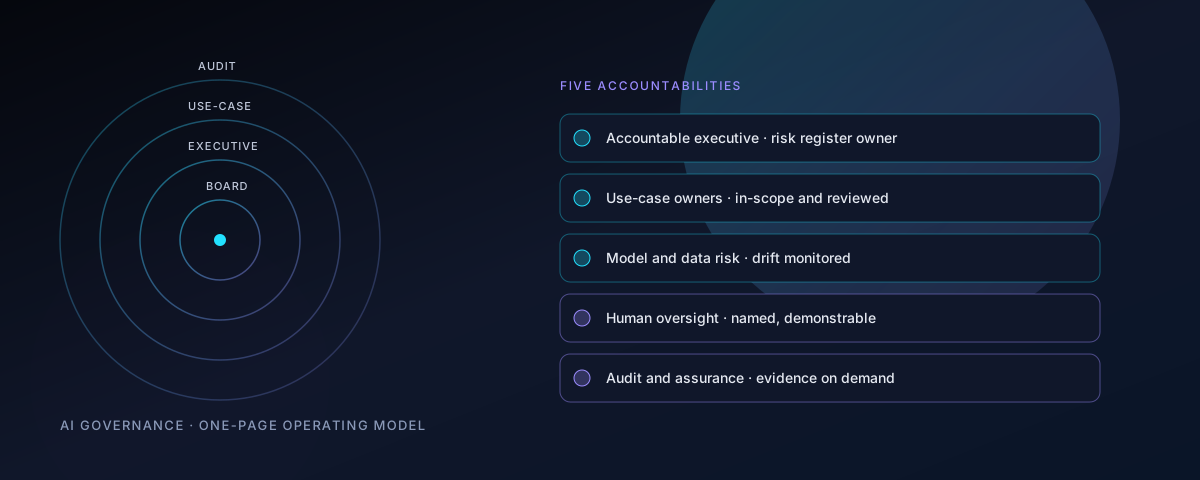
At a glance. Australian directors are accountable for AI outcomes whether or not they think of themselves as “tech people”. This is the one‑page operating model we use with boards: who owns what, what evidence to require, how to think about sovereignty and model risk, and the questions that keep an AI program from becoming a governance liability.
For most of the last two years, AI has been a strategy item on the board agenda. In 2026 it is increasingly a governance item — with the same expectations of named accountability, documented decisions and evidence that directors apply to financial controls, cyber risk and modern slavery.
This is the operating model we use when working with boards in regulated Australian sectors. It is not legal or director‑duties advice. Treat it as a scaffolding tool for your audit and risk committee.
Why “AI governance” is more than “AI strategy”
A strategy answers what the organisation will do with AI. Governance answers how the organisation will know it is being done well — and how it will explain that to a regulator, an auditor, a court or a customer.
The shift matters because the regulatory direction in 2026 is consistent across jurisdictions: AI is not regulated as a separate thing; it is regulated through the lenses of privacy, ADM transparency, consumer protection, professional standards, financial services obligations and information security. Directors who treat AI as “the tech team’s problem” inherit governance gaps in every one of those lenses simultaneously.
The five accountabilities
A workable operating model assigns five accountabilities, each with a named role, a reporting cadence and a defined evidence set.
1. Accountable executive
A single named executive is accountable to the board for AI outcomes — typically the CIO, CTO, COO or, for smaller organisations, the CEO. The accountable executive owns:
- The AI risk register.
- The AI policy and standards.
- Vendor risk assessments for AI subprocessors.
- Incident response when an AI‑involved decision goes wrong.
2. Use case owners
Every production AI use case has a named business owner — payroll, claims, drafting, evidence assembly, etc. The owner certifies that:
- The use case is in scope of policy.
- Inputs are appropriate.
- Outputs are reviewed where required.
- Sunset criteria exist if the use case stops being justifiable.
3. Model and data risk
A risk function reviews AI model selection, retraining, evaluation and drift. For most organisations this is a sub‑function of operational risk; for financial services, it sits within model risk management aligned to APRA expectations.
4. Human oversight
Where AI affects customers, employees or regulated outcomes, human oversight is named and demonstrable. Not “a manager will check”. Specifically: which role, with which evidence, in which system, with what authority to override.
5. Audit and assurance
Internal audit (or an outsourced equivalent) periodically tests:
- That AI use cases match the inventory.
- That oversight controls actually fire.
- That training, policy and contracts reflect current operations.
- That regulator‑ready evidence can be produced on demand.
What evidence the board should require
A director does not need to read prompts. A director should be able to ask for, and receive within a reasonable timeframe:
- The current AI use case inventory, with risk ratings.
- The incident log, with root‑cause analysis on material events.
- A vendor list, with sovereignty posture and subprocessor disclosures.
- A model and data lineage statement for high‑stakes use cases.
- A summary of human override and approval rates in the last quarter.
- An attestation that the PII boundary is enforced before content reaches an AI model.
If any of these takes weeks to produce, that itself is the governance finding.
Sovereignty and the data‑plane question
In 2026, sovereignty is no longer a hosting checkbox. A board should ensure that:
- AI inference, vector search and observability data stay onshore for regulated workloads.
- Subprocessors of subprocessors are disclosed and reviewed annually.
- A data‑flow diagram exists for every material AI use case — and is more current than the marketing diagram.
The architectural detail behind this is in our companion piece, Sovereign AI in Australia: what changed in 2026.
Determinism: the line that protects the board
The single highest‑leverage architectural commitment a board can endorse is this:
Where the wrong number could cause material harm — to a customer, an employee, a participant or a counterparty — the number must be produced by tested code, not inferred by a language model.
This is not a limitation on AI. It is the difference between an AI program a board can defend and one it cannot. The reasoning is laid out in Why we put deterministic engines under our AI.
The 12 questions for the next ARC meeting
Use this list verbatim or adapt it. Asking the questions creates the artefacts.
- Who is the named accountable executive for AI outcomes in this organisation?
- Show me our AI use case inventory. When was it last reconciled to operations?
- Which use cases are high‑risk under our policy, and what controls apply?
- Where does AI inference for those use cases physically run?
- Which subprocessors process customer or employee data through AI features?
- How is PII detected and contained before it reaches an AI model?
- Which AI outputs require human approval before external use?
- How would we replay an AI‑assisted decision from six months ago?
- What is our process when a customer contests an AI‑involved outcome?
- How are AI vendor changes reviewed (model upgrades, new subprocessors, new regions)?
- How do we know our AI features are still aligned to current regulatory guidance?
- If a journalist or regulator called tomorrow about AI in our organisation, who answers, and with what evidence?
How opzo.ai supports the operating model
Every opzo.ai application is engineered to make these answers easy to produce. Cited reasoning, persisted traces, deterministic engines, PII detection at the AI boundary, Australian Azure regions, transparent credit ledger and audit‑grade logging are not premium features — they are the platform default. That is deliberate. We want boards adopting opzo.ai to find that the artefacts they need on day one are the ones their teams already have on day zero.
Next step
If your audit and risk committee would like a working draft of this operating model — adapted to your industry and current AI footprint — contact us. We are happy to share the scaffold under NDA and walk through it with your accountable executive and risk lead.